Weeknotes out in the wild…

We appear to be stepping boldly into a brave new world where we publish our week notes in the open *, so not wanting to be left behind I’ve popped this up on Medium too.

Highlights from last week

  • The week began with welcoming Cate Mclaurin to our team. I’m really pleased to see our new colleagues coming on board to help us crack on with the next stage of the work we’re doing, and I’m very much looking forward to working with Cate and learning from her experience in central government and ACAS.
  • Our office became a film studio twice last week. On Tuesday we produced a short set of clips which featured several of our people talking about what it’s like to be part of the HackIT team — we’ll be releasing the video this week to support our apprentice recruitment. And on Friday afternoon the Mayor was filmed in our meet and greet space for a video statement setting out Hackney’s support for digital collaboration across local government. (Watch out for more about this later in the week…!)
  • We’ve had lots of interest in our apprenticeship programme, and I’ve had several calls over the last week to share more of the background to that with colleagues elsewhere. I talked through the background (as per my recent blog post: https://blogs.hackney.gov.uk/hackit/delivering-digital-change-for-the-long-term-with-apprenticeships) and shared more details about the roles that we’re recruiting to. So far the feedback has been very positive so I’m now even more aware of the pressure on us to make sure that the programme is a success!
  • I’ve also been having follow up conversations with the people who took part in our Mayor’s Digital Advisory panel a few weeks ago. I’m using these to gather their ideas for how we can develop this and use it to help guide our digital direction for Hackney.
  • Thursday was our quarterly Divisional Management Team away day, where we set aside time to discuss some of the bigger picture issues and opportunities that we need to think through. I find these very useful sessions and we covered some important topics that we’ll be focusing on over the coming months.
  • I have regular catch ups with other directors and at the end of the day on Thursday afternoon Lucy and I caught up with Sarah, our Director of Children’s Services. I was very pleased to hear the positive feedback from Sarah about her teams’ move to our new productivity tools last week and it was particularly encouraging to spend the time discussing how they’ll be able to use these to work in more flexible and collaborative ways. We talked about how we can share learning from the changes we’ve made to our ways of working in ICT and how we might provide topic based support and advice sessions for Sarah’s teams to help them explore new ideas for their service.
  • We’re hard at work preparing for the procurement of our new end-user devices and I was pleased to see that we’ve been able to make a significant saving on licencing through good timing and smart procurement. We’ll be doing the work to buy hardware soon, but before we do that we’re making sure that we dig in deeper to understand user needs — particularly to help us figure out where teams’ working styles would make laptops the best option and where flexible desktop access would be the better fit. Designing this through working with users is a really important part of our commitment to follow the Local Government Digital Service Standard: https://localgov.digital/service-standard/point/understand-user-needs.
  • Delivering up to date software tools and hardware is only part of the changes that we’re making to help modernise our workplace at Hackney. Equally important is helping colleagues think through how they can best use these to manage their information effectively and this is another area where understanding user needs and learning together is really important. We know that introducing whole organisation level file plans is very difficult and is often a poor fit with the way that services work, so on Friday Anita and I spent time catching up with the Exec Support and Mayor’s Office teams getting up to speed with the good progress that they’re making and helping to identify areas where we can provide additional support.
  • I wrapped up the week with a conversation with some colleagues in HR planning ahead to a presentation that we’ll be giving together at next week’s Senior Manager Network meeting. This was a good opportunity to show how we can use video meetings to meet up quickly without all needing to be in the same place at the same time. It worked really well and we were able to agree the way forward in a brief meeting, rather than lots of emails having to go back and forth.

Something I’ve learned this week

I’ve been taking time to check in with people who’ve moved over to our new productivity tools to see how they’re getting on. I find it useful to make sure that I’ve got a good understanding of how changes that we’re delivering are bedding in and have never liked the notion that senior managers shouldn’t make the time to understand detail. While it is important to have a big picture view I think that needs to be connected with the reality ‘on the ground’ too, as otherwise it’s easy to make decisions without understanding the potential implications. I’ve realised that I need to make sure I explain that, as quite a few people have been surprised that I thought it was a useful use of my time to spend half an hour with them looking at how they’re using their email.

All the best,

Rob

* Cate got there first (by many weeks!): https://medium.com/@cate.mclaurin/weeknotes-20-week-1-being-new-being-welcomed-a134aec8ef45 and Matthew’s made the leap this week too: https://medium.com/@mcaino/week-notes-v2-0-969645acac80.
Delivering digital change for the long term with apprenticeships

We’ve been thinking hard about how we can best make sure that we have the skills that we need to help Hackney continue to improve the services we provide for our residents and businesses.

Having an in-house ICT and digital team means that we can be lower cost, more agile and service focused, and can avoid wasting time on contract change controls when we need to respond to the changing environment we work in. But to make this work well it’s critical that we invest in our people’s skills and learning, and that we plan for the longer term. We are also acutely aware of the importance of encouraging more diversity in the technology sector and see ourselves as having an important role to play in that.

Part of this is putting in place well thought out training opportunities for our teams, including having our people work alongside the expert agencies who are helping us deliver a wide range of exciting projects so that we can learn from them. Getting our training approach right is a priority for us and something we have committed to as part of the restructure that we completed recently.

Another key component of our workforce strategy is using apprenticeships to bring in our next generation of skilled people. We also think this will help us to keep our thinking fresh across the whole service by bringing in new ideas and understanding.

Hackney have had a long standing commitment to offering apprentice and trainee opportunities and we are building on this by taking advantage of the opportunity presented by the apprenticeship levy. We’ve now created 18 new ICT and digital apprenticeships (based on level 3 and level 4 accredited apprenticeship qualifications) across a range of roles covering:

  • Applications management
  • Data analysis
  • Development and integration
  • Digital service design
  • ICT infrastructure engineering
  • ICT support

This represents more than 10% of the posts in our team and we think that this will be a really big step forward for us. We start the recruitment to these roles on Monday 18 June and we expect to have our apprentices joining our team after the summer holidays.

Doing this in Hackney is particularly exciting. The borough’s schools have had an amazing transformation and now count among the best in the country. This gives us a great pool of local talent and skill to draw on and we hope that having the opportunity to contribute to improvements in their local borough will be something that makes our roles an attractive proposition for local young people.

Hackney also has a thriving tech sector with world leading business (large and small) based in the borough. On Monday 11 June we invited local employers to meet with us and discuss their ideas for ways that we can make our apprenticeships a success. Lots of really good suggestions were put forward, including:

  • Making sure that apprentices are given specific projects to deliver so that they can build their own personal portfolios of experience
  • Supporting our managers with the skills they will need to manage people who are at an early stage of their careers and have limited experience of the workplace
  • And also a willingness to work together in future to share ideas and look for further opportunities for us to work together

We’re really looking forward to getting our digital apprenticeship programme started and working to deliver great results for the apprentices and for Hackney as a whole.

Smart London Camp 2018

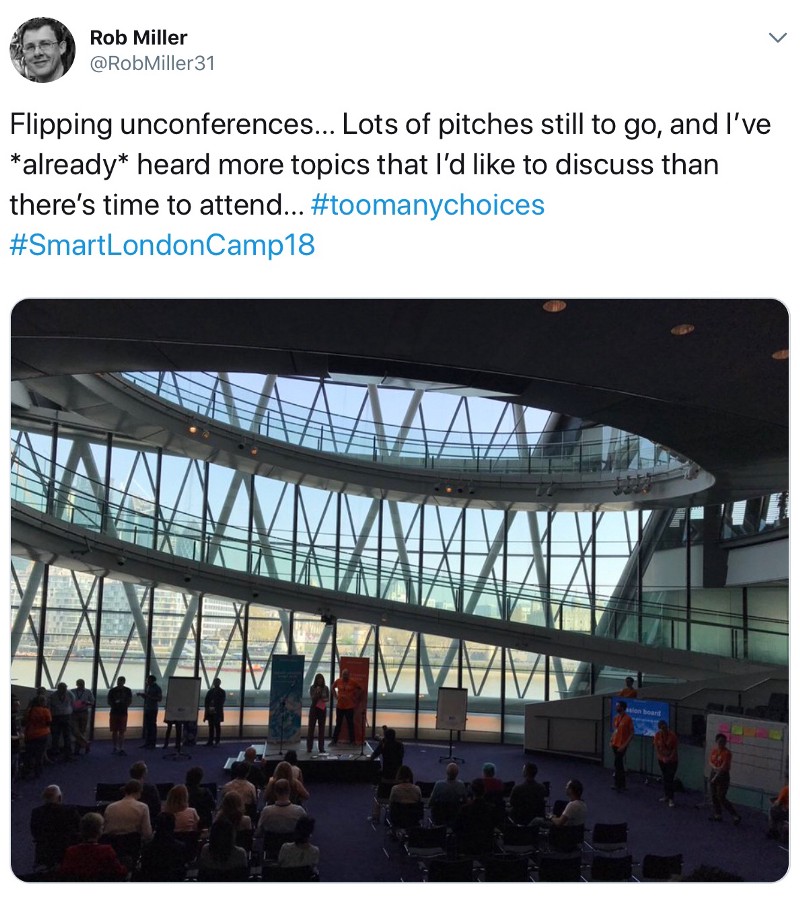
Yesterday I joined a large group of people whose idea of the best way to spend a beautiful sunny Saturday was to gather together in London’s City Hall and discuss ideas for ways that London can get the most out of the opportunities that ‘smart city’ developments offer.

I found it a really interesting and useful day, hats off to @LDN_CDO Theo Blackwell for gathering together a really impressive group of people and a huge thank you to everyone involved with organising the day (especially those who’d come in from places as far away as Devon to help make sure that the day ran smoothly). I really enjoyed catching up with colleagues and contacts I’d met through the Twitter-sphere but hadn’t met before in person, and I also got to meet lots of new people who have a shared passion for civic technology.

As with Local Gov Camp last autumn, I found myself struggling to decide which sessions I wanted to prioritise attending because there were too many interesting topics pitched by attendees… (the full session list is online here: https://docs.google.com/spreadsheets/d/1nL9xrbkclyVlSyMRcRC4bUv0EQUcOEmVv0h3z4NO1x4).

In the end I picked sessions covering:

  • Data gathering from internet of things technologies in public spaces
  • Use of smart technology to improve our environment in London
  • Ways that we can understand the value of our data
  • Ideas for building data literacy and an informed data culture
  • How we might create a culture that celebrates failure as a necessary part of innovation

Here are a few notes of things that I thought were particularly interesting from the sessions. (With apologies to the pitchers / conveners of the sessions where I didn’t note down their names!)

Data gathering in public spaces

My first session was a discussion was pitched by @rossatkin and was an opportunity to reflect on the use of ‘smart’ infrastructure in public spaces and the risks of potentially alarming levels of surveillance without public awareness and control. Some of the people taking part in the conversation worked for companies (large and small) who are developing technologies in this field and that made for a healthy and interesting discussion.

My key takeaway from this was that we risk a pendulum effect, swinging from doe-eyed tech enthusiasm with no checks and balances, over to ‘ultra’ levels of anxiety about what might be possible, potentially inventing concerns that don’t actually exist. Recent news has highlighted a number of examples of where not understanding data gathering and sharing can result in concerning consequences, and I think it’s really important that we have a measured discussion about data ethics and the limits and controls placed on data gathering (which inevitably links to how we approach GDPR). I think that a key area is understanding the powers that local, regional and national government actually have to influence this and also people’s awareness of what they are trading in return for access to otherwise useful services. (Jaron Lanier’s book ‘Who Owns the Future’ is a good read if you’re interested in this: https://www.theguardian.com/books/2013/feb/27/who-owns-future-lanier-review).

Using smart technology to improve our environment

This session covered a wide range of topics including the cleanliness of public spaces, air quality and recycling. Some of the points we talked through are fairly widely covered already, but there were interesting points raised about how regulation can be used to encourage positive behaviours and outcomes, how smart use of data might encourage people to recycle more (eg gamification type approaches) and other cultural ‘nudges’.

My conclusion at the end was that there is quite a lot that we could learn from how retailers are exploring smart technology for marketing. And I think we should be thinking about how we can use existing global scale platforms to do this, not creating niche public sector versions of Facebook etc.

While there are obvious and important concerns about privacy and the appropriate use of data which will need to be taken into account, it strikes me that there could be important opportunities to encourage people and communities to live in more environmentally sustainable ways which I’m interested to explore further.

Understanding the value of data

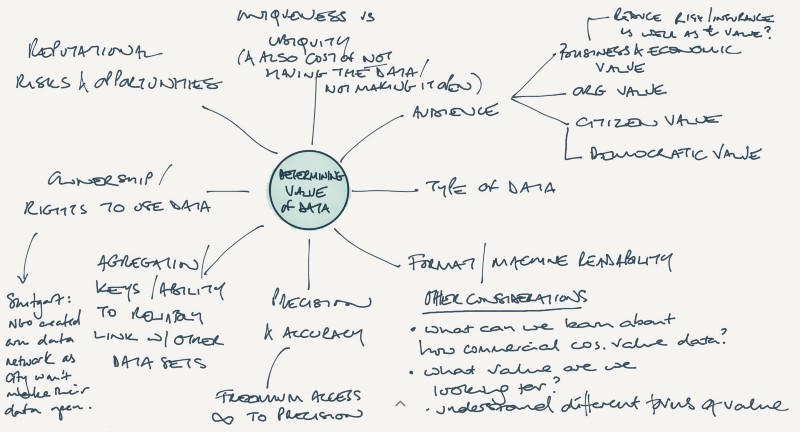
I was intrigued by the pitch for this session, which was asking how we might put a value to the data that is held by the public sector. After an initial moment of alarm when producing equations was mentioned (it’s quite some time since I did my A level Maths…!), it developed into a very interesting discussion which made me think.

We talked through a number of different ways that we can assess the value of data, and also reflected on some of the ways that value might be maximised (or reduced). If you can read my scribbles my sketch below captures some of the points we talked through.

I was particularly impressed by the way that Transport for London look for wider societal value from their data with a real focus on making it open and accessible, resulting in a large number of independent apps that use TfL data in useful ways. It also occurred to me that we need to consider the constraints that we might inadvertently put on this value if the way we publish data is too restrictive. It’s a delicate balance of public value, respect for privacy and understanding how data is impacting on the wider technology and civic ecosystem.

Building data literacy and a data culture

This was a really interesting session run by @holly_armitage and @la_gaia, looking at a number of aspects of data literacy and culture. This was also the session that made us do most standing up and moving around, so my notes were much more limited than for other sessions!

I found it interesting to reflect on how we could consider different levels of data literacy, with a foundation level being to make sure that people know enough to prevent harm, and also the different but linked responsibilities across business, government and citizens themselves. I was also struck by the suggestion that there might be parallels with other social changes, such as car ownership, where individually rational behaviour (ie owning a family car) actually has profound societal effects when a large proportion of the population do the same thing.

Creating a culture that celebrates failure

@greenman pitched this session and introduced us to the 2-4-more approach for running a collaborative workshop (I might have got the name for that wrong!). I really liked this and will be stealing it for team events I’m running soon. It starts out with people working in pairs, then doubles that by joining pairs up and finally the group feedback together. I thought that this was a good way to explore ideas quickly and also gave people who don’t like speaking out to a large group more opportunity to share their thinking.

There were lots of useful ideas from this session and a general view that iterative, agile approaches reduce risk by making ‘failures’ smaller and more visible early on, making it relatively easy and low cost to make course corrections, whereas ‘waterfall’ approaches often result in the issues building up until there’s a much more traumatic event later on in the project. I shared how we have built some of these ideas into our #HackIT Manifesto (http://hackit.org.uk/how-we-work/hackit-manifesto), setting out ways of working that we are adopting across our team, and our use of week notes to work aloud – including the suggestion that Matthew Cain (our Head of Digital & Data) made recently that we include lessons we’re learning as part of that to encourage a culture where failure is OK and the key is to learn, adapt and improve.

The main question I’m now asking myself is whether we need to be doing more to share the lessons we’re learning with our senior colleagues. It struck me that there’s a risk that even if a team is working in an agile way, if senior managers don’t see how learning is being built into their work we might risk looking more polished than we actually are and miss an important part of changing the way that we make decisions at senior levels.

A few thoughts about buying and suppliers

I wasn’t able to get along to the session that was looking at improving the ways that the public sector buys technology, as it clashed with one of the other sessions I wanted to go to. But I’d definitely recommend that people check out the UK Government Digital Marketplace (https://www.digitalmarketplace.service.gov.uk). We’re using this extensively at Hackney and are finding both the G Cloud and Digital Outcomes & Specialists frameworks incredibly useful, helping us to buy better services, at lower cost, dramatically faster than has previously been the case with other approaches (OJEU etc). We’re still learning how to get the most from these and recently held a conversation with a group of the suppliers we’ve been working with to hear about their experience of selling to Hackney and reflect on ways that we can improve further (you can see what we learned from that on our blog here: https://blogs.hackney.gov.uk/hackit/working-with-suppliers-to-develop-better-digital-services). If you’re a supplier interested in selling to the public sector I would strongly recommend looking into getting your services onto the Digital Marketplace.

I also thought it was worth noting the quality of the conversations that I had with people from the supplier community at the event. I’ve found that other conferences have often involved far too many ‘hard sell’ conversations, which actually results in me going out of my way to avoid having to speak with any suppliers. And experience of unsolicited marketing online and by email has had a similar effect, resulting in a recent collaborative effort to write up an ‘Unsolicited Marketing Service Standard’ spelling out the behaviours that we would like suppliers to follow: https://docs.google.com/document/d/14F2qqLUcOOo41VGA6bVKxjF-fxZicUv-GrGXefyXzUk. Yesterday was quite different. I met lots of people who work for companies (large, medium and small) that sell into the public sector and I didn’t have any of the dreaded ‘please get me out of here’ moments. It was really reassuring to find such a consistent focus on exploring interesting topics and looking for ways that we might make things better for citizens, and I learned a lot as a result.

Thanks again to @LDN_CDO and everyone behind the event for a really valuable day!

A Digital Detente

A fairly common theme in conversations I’ve had over the years has been the struggle between ICT and digital teams — where the IT team are perceived to be the ‘department of no’ and the digital team have acquired a reputation for being all about creating whizzy websites, but not caring much about the steady sustainability that’s needed for ‘proper enterprise systems’ and security.

I think it’s time we put this behind us.

It’s time for ICT to get with the programme

A fundamental purpose for the IT team should be to provide a platform that makes it possible to deliver digital services that are so good that people prefer to use them. Security can not be fit for purpose if it results in services which are so difficult to use that people don’t use them, or worse leads to workarounds that actually put sensitive information at greater risk. And all the architecture and robust systems management in the world will be useless if it isn’t able to move at the speed of business.

Obviously, this isn’t without its challenges. In a complex business environment (especially somewhere like local government with hundreds of different services which are usually reliant on legacy systems) the ‘move fast and break things’ mantra of digital native companies like Facebook isn’t a good fit (in fact, Facebook dropped that too as it had reached a scale where it needed a less cavalier approach). Many of our key systems have their origins in the e-government days of the early 2000s and whether or not these are fit for the internet age largely depends on suppliers over whom we often have frustratingly little influence.

We need to find ways to extract ourselves from these legacy platforms, leapfrog technology barriers and lay the foundations that will allow us to get off the treadmill of endless incremental updates to outdated technologies. Fortunately, there are lots of opportunities for us to make a start on this, using platforms that can be deployed in a fraction of the time that systems implementations used to take and by adopting modern open standards that will allow us to start taking greater control over our destiny. It’s not without complexity, but accepting that Yet Another Big System Procurement isn’t the answer is probably a good place for us to start.

(As an aside, @Matt’s podcast here is worth a listen for a more in depth look at reasons why corporate IT is often the way it is: https://wb40podcast.com/2017/06/19/wb40-podcast-episode-27-the-why-of-corporate-it)

And ‘digital’ will be a flash in the pan unless it can work in harmony with ICT

I think it’s equally important to make sure that ‘digital’ doesn’t become an ivory tower that exists in glorious isolation from the wider systems and information ecosystem that digital services need to be part of if they’re to be truly valuable and sustainable.

I’ve long been a fan of the GDS Design Principle of ‘Do the hard work to make it simple’ (https://www.gov.uk/design-principles#fourth). I think this applies as much to the systems and information context as it does to understanding user needs and service design. While ITIL-esque management practices can seem bureaucratic and frustratingly cautious, there are underlying principles at the heart of them which are important and shouldn’t just be dismissed.

I actually think that lots of the skills involved in digital ways of working can be enormously valuable for the management of ICT platforms too. So an effective and mutually respectful collaboration can have huge benefits in helping deliver better services for our users.

Time for a manifesto…

At Hackney we’re fortunate that the Council has organised the traditional IT responsibilities and digital roles together as part of a single integrated team. The Council is also clear that this combined function is not a ‘back office’ service, but actually needs to be at the heart of how we continue to deliver better services for the borough’s residents and businesses in spite of the severe cuts to our funding by central government.

Some years ago I mused about the need to replace IT strategies (and indeed ‘digital strategies’) with a manifesto that sets out what we’re for and how we’re going to work together: https://bytherye.com/2013/08/28/does-ict-need-a-manifesto/. We’ve now done this and have created our ‘HackIT manifesto’ which sets the principles that we will follow to make sure that all areas of our team are working together with a shared focus: https://bit.ly/HackITmanifesto. We’re applying this to all aspects of our work and it’s proving a very effective tool that we can use to make sure that we’re doing the right thing in the right way — with digital and ICT working together and learning from one another.

(If it’s of interest, the team blog about the work we’re up to together here: http://blogs.hackney.gov.uk/hackit/)

The Wile E Coyote moment

I was very taken with Benedict Evans’ description of the way that companies like Nokia and RIM (BlackBerry) responded to the advent of the iPhone in 2007:

You might call this the ‘Wille E Coyote effect’ – you’ve run off the cliff, but you’re not falling, and everything seems fine. But by the time you start falling, it’s too late.

(Full article here: http://ben-evans.com/benedictevans/2016/2/19/mobile-smartphones-and-hindsight)

Ten years later, the way that the smartphone has become such an intrinsic part of our everyday lives seems perfectly natural, but it’s fascinating to reflect on how much has changed in a such a relatively short period of time. * The first iPhone’s specs (http://m.gsmarena.com/apple_iphone-1827.php) were incredibly basic when compared with devices now. ** It didn’t have 3G, there was no video camera, it had a screen that was tiny and very low resolution by contemporary standards, and you couldn’t even copy and paste! I think it’s well worth taking a moment to consider what nascent and ‘not quite there yet’ technologies around today are going to have this sort of impact in the next decade…

And the implications of this aren’t limited to gadgets.

My first job after graduating was working for a specialist wine company at a time when their business was being challenged by the big supermarkets, who had realised there was good money to be made providing shoppers with the opportunity to pick up their regular tipple along with their groceries. Despite our best efforts we couldn’t stop the ground shifting beneath our feet and ultimately the company folded. Meanwhile one of our competitors seemed to be breaking all the rules (no town centre shops, case sales only etc) and yet they managed to turn in year on year profit and growth. ***

What I learned from that was that the answers to the challenges we face often aren’t just pushing harder to make our ‘proven strategies’ work.

This is a lesson which seems very relevant to the challenges of working in local government and technology today. The dramatic reductions in council funding (cut by something like 50% from 2010 levels) and the astonishing pace of change in technology mean that we need to challenge all our preconceptions and ask hard questions about what we do and how we do it.

But as well as being very challenging for us and our colleagues, I think this also presents a real opportunity for creativity. Exploring new techniques and technologies, combined with different ways of working and closer partnerships, can help us focus on the citizens we serve and gives us the opportunity to make a real difference. And that matters. A lot.

* I realise that this isn’t unique in the history of technology. For example Microsoft’s success in achieving the audacious (at the time) goal that Bill Gates articulated in 1980 of having ‘a computer on every desk, and in every home’ is equally impressive and transformational.

** I held off getting an iPhone or other smartphone for several years because I couldn’t find one I wanted that included an FM radio like my Nokia N96. Seems bizarre in retrospect!

*** The happy ending is that later on former colleagues managed to resurrect the company, and are now doing a great job of doing what we did best – selling great wine from amazing producers, but with fewer shops and less emphasis on big brands and big ‘discounts’.

Designing the future of work

A new year and a new commitment to updating this blog a bit more frequently than once every year… I’ve decided that little (ie more than I can fit into a tweet) and often(ish) might be the way to go. Let’s see…

A theme that’s popped up in quite a few of my conversations recently has been how to design a work environment that’s fit for the modern age and which will help our organisations attract our next generation of superstars. It’s a tricky and fascinating topic, full of competing tensions:

  • how do we shift our management cultures from managing activity to delivery of outcomes?
  • if trust is key to this (I think it is), how do we shift our attitudes to risk, especially if the consequences of something going awry could lead to reputational or financial damage?
  • when we design our services, processes and technology how do we get the right balance between the needs of our more experienced staff and those of the newer generations, who are likely to be more familiar with Snapchat than the tools we thought were cutting edge in the 1990s but which often still prevail today?
  • and how can we make sure that work is meaningful, harnessing our people’s motivations to deliver the best results?

I suspect that there isn’t a template answer to this (and I don’t think it’s a sector specific challenge — this applies to public and private sector organisations) and that the key is to tune into the organisation and find the right stepping stones to get moving in the right direction. But I’m sure that the answer is not to simply maintain existing paradigms and try to squeeze those into new technologies and ways of working (which will probably get you to this sort of thing: http://www.theverge.com/circuitbreaker/2016/4/29/11541614/apple-watch-running-windows-95-video).

Here are a few of the links which I’ve found thought provoking:

  • this video on the future of work: https://www.youtube.com/watch?v=G11t6XAIce0&t=6s (I thought this was a great explanation of the idea that ‘work is a thing you do, not a place’)
  • Matt’s #noPC challenge: https://mmitii.mattballantine.com/2017/01/05/nopc/ (my take on this is that it’s about more than just not restricting people to using PCs to get their work done, there’s a real need for purposeful focus on designing services and tools that enable the widest possible choice and flexibility)
  • Ben Thompson’s analysis of the impact that Amazon’s Alexa might have on the future of computing: https://stratechery.com/2017/amazons-operating-system/ (‘normal’ / ‘what I’m used to’ is not the same as ‘eternal’, and be mindful of the potential for shiny things to lure you into a vortex you weren’t expecting…)
  • and I also found Simon Sinek’s thoughts on the Millennial generation really interesting: https://youtu.be/hER0Qp6QJNU (15 mins, watch it through)

On collaboration

I thought that this article from the Economist on collaboration that a colleague pointed out to me last week was an interesting read. It warns that in this age of Slack, chat rooms and instant messaging we are at risk of ‘over-collaborating’.

I can see the sense in this argument, and I definitely recognise how precious focused time has become, and also the challenge that both individuals and delivery teams face in preventing continuous interruptions from affecting their work. It made me think a bit more about what ‘collaboration’ means to me and the role I think it should have in how we get work done.

On reflection I think there are possibly two separate dimensions to how collaboration tools are changing the nature of work.

1. There are some aspects of collaboration which, in my view, are purely positive. For example, working together on the same document (moving away from what was essentially the distribution of electronic pieces of paper to working collaboratively as a team on shared information) has taken away loads of low value work and effort merging feedback and edits, and has also changed the character of the work we do together.

Since adopting Google Apps for Work my team and I now very rarely send each other copies of our work in the way we did before, and it now feels distinctly odd if we aren’t collaborating in real time on shared documents and information.

2. But many collaboration tools are also rapidly increasing the volume and speed that information flows at. I am convinced by the qualitative benefits that social tools like Slack, Google+ and Yammer etc can bring by making teamwork more open and shared, but do agree that they can also add to a sense of being overwhelmed (amplifying some of the well documented problems that email causes us: https://bytherye.com/2015/11/02/is-email-here-to-stay/). There can be some respite in picking up a new communication tool that only a few people are using, but it often won’t be long before take up grows and it becomes yet another crowded space.

Part of the answer to this is likely to be technology getting ever smarter and helping us filter out the information that’s most important and deserving of our attention (which will be one reason why the big technology companies are investing so much in artificial intelligence developments). But I think this will only take us so far, and it will also be essential to think very hard about how we manage our own time, work styles and our expectations of others. A very human challenge…

Is email here to stay?

This post from @ballantine70 hit on a favourite topic of mine: Five hurdles between us and the death of email. Are we doomed to suffer with email for ever? What gives email its staying power? And am I missing something which explains its popularity despite the regular complaints I hear about “email overload”?

Personally, I think that the biggest weaknesses of email are:

1. The assumed SLA

‘I sent you an email so I expected that….’.

I think that this is one of the main reasons that people become overwhelmed by email, and also for work getting stuck as people wait for replies rather than finding more effective ways to collaborate with their colleagues. (I once heard this described as ‘trying to deliver a project by mail order’)

2. The escalation effect

It seems to me that email is often written as casually as an off the cuff text message, and then read as seriously as a memo from the Chief Exec. This mismatch often seems to result in major rows (and also potentially long term working relationship issues) that wouldn’t happen if the issue had been discussed with a less formal approach (by which I mean a quick call or chat — but I’m also seeing brilliant examples of how instant messaging and social media tools can work really well in a business environment too).

3. The time vortex of pseudo-collaboration

I dread to think how much time gets lost in business as people try to knit complex discussions held by email and multiple versions of documents shared by email back together into a coherent form. And that’s before you factor in how much valuable stuff also inevitably gets lost in the process…

A joined up instant message thread, comments on a social media post, and genuine collaboration working together on a single document are transformational in their impact on the pace and quality of work.

We’ve been seeing brilliant examples of how teams are using Hangouts instant messaging and video meetings, Google+ and real-time collaboration on documents to totally change how they work together — for the better. And this includes working with partner organisations. It’s really exciting to see how simple, user friendly, web based tools are helping to make work more collaborative and more productive.

I think Matt’s absolutely right about the importance and the sticking power of email, but I’m also convinced that there’s a better way to get work done now that we’re well into the 21st Century. My favourite initiative is ‘Project Zero’ which is the name that one of our front line service teams have given to their plan to banish email and use better tools for their internal collaboration and communication. It’s not the kind of thing you’d typically associate with working in local government, but I have a feeling that they’ll make it work! 😀

 Watch… a few thoughts after my first week

An ever so slightly geeky digression.

As an avid iPhone user I was intrigued to find out what an Apple Watch would offer. I think it’s interesting to consider whether the emergence of the ‘smart watch’ is just a fad that will soon vanish (in the way that Google Glass seems to have disappeared off the radar for the moment), or whether we really are at the start of an important new stage in the way that we use technology. I realise that Android smart watches have been around for a year or so now, but as those currently require an Android phone they haven’t really been a viable option for me.

So, ten days ago I got a knock at the door and, with roughly the same level of excitement as my six year olds unwrapping a Lego set, I set to opening up what turned out to be a remarkably heavy box given the size of the contents. These are some initial observations on how I’ve found the experience so far and where I think that this new category of device might be important in future.

The short version: I’m really quite liking the Watch. It’s a very nice device, has lots of potential, but unless you’re a bit of a geek I’d probably recommend waiting a bit before leaping in.

The longer version: having used a Jawbone Up for some time a couple of years ago, I was fairly familiar with the life tracking dimension of wearable devices. The Apple Watch misses out some of the features that I liked about the Up (notably sleep tracking), but is definitely quite a different device in the range of things it can do. The main things that have struck me so far are:

1. The battery life has been a very pleasant surprise. So far I’ve comfortably got through the day with at least 50% battery life to spare, and I just about managed to get it to last two days when I gave that a go. I expect this will reduce as I get into the habit of using it more, but the fears that the Watch wouldn’t make it through a full day seem quite misplaced based on my experience.

2. Notifications are handy — but only if you filter them down quite significantly so that you only get alerts for the stuff you care about most. I’m already fairly stringent with which apps I set up for notifications on my phone, but I’ve cut out about half of those from the Watch as I didn’t want a constant tapping on my wrist to become yet another source of distraction. I’ve seen quite a few people observing that they check their phone less frequently once they get a Watch and I think I’m finding the same. It’ll be interesting to see whether that gives a noticeable benefit in reducing time wasted grazing stuff on the phone and possibly also the phone’s battery life…

3. Apps need careful thought to get the most from the Watch’s user interface (I thought that this post did a good job of explaining the thinking process that goes into getting it right). Just like with apps for smartphones, too much or too little results in a poor user experience, but where developers have got it right I’m finding that the Watch can be a genuinely useful device.

My favourite discoveries so far include:

  • Quick actions. For example, I like that I can quickly tick things off my ‘to do’ list using the Watch.
  • Remote control. I’m finding it really neat to be able to choose which music and podcasts I want to listen to without needing to reach for my phone (I rarely use Siri for that when I’m out and about as (a) I feel like a bit of a prat — although I realise that it’s arguable whether or not using my Watch to do this has a similar effect!, and (b) I’ve not found it very accurate). This is my favourite feature at the moment.
  • Walking directions are also a nice feature when I find myself somewhere I’m not familiar with.

But while I like getting notifications for messages and priority emails on the Watch, I am a bit sceptical about using it as a communication device. I’m not sure how to reply with a preset short message without unintentionally coming across as a bit curt, and while Siri oddly seems to be more accurate when I’ve used it on the Watch, I can’t see myself rattling off replies using dictation. But maybe that’s just a personal preference?

edited to add: this evening brought an example of how to get it wrong when developing apps for the Watch. I was excited to see that the National Rail app had added an Watch app, and was pleased to see that they’d trimmed down the features for the Watch. But what’s with giving you the full departure board details for your ‘favourite’ stations (in all directions), and not the details for your ‘favourite’ journeys (i.e. the thing you might actually want to quickly check without fishing for your phone!)? Hopefully that will get fixed soon enough, but honestly!

5. I haven’t been in the habit of regularly wearing a watch for a while, but I have heard a few people comment that they don’t think that they could see themselves leaving their treasured timepieces at home in favour of a smart watch. It’ll be interesting to see if that remains a barrier to adoption for people, or whether smart watches become sufficiently useful that people change the way that they think about their watch.

6. If smart watches do become genuinely useful and widely used, its going to be interesting to see what impact it will have on our mobile strategy. Currently we’ve chosen to favour responsive web design rather than native apps (in line with the principles articulated by Government Digital Service in their post here). But as the Watch doesn’t have a browser this could need to change. I don’t think that’s an urgent issue right now, but it is one to keep an eye on to make sure that we don’t get caught out.

7. My final observation is that morse code could well be in for a renaissance as a tool for gossip using Digital Touch! But I might wait until a few more people have an Apple Watch before I get the old code books from my Scouting days down from the loft…!

And the really short version…

An interesting model for supporting BYOD

As I’ve blogged before (probably too many times!), taking a much more flexible approach to the types of devices we enable for connection to our systems and services feels like an inevitability, and something those of us responsible for providing business IT services need to be prepared for. A Canute style refusal to accept this seems like a great way to make ourselves irrelevant in quick order.

As well as the much discussed security issues that we need to figure out, this also presents complex new questions for how we provide support to our users.

  • How much support do we provide for personal devices and how much help do we provide to our users for getting their access set up?
  • What do we do if a BYOD device breaks?
  • How do we manage the transition from a highly standardised device model to one where we’re actively encouraging diversity?
  • And how do we manage the cost of this?

I thought that this model from Steve Halliday in Solihull looks like a really interesting approach. I like the idea of a points system, and think it could be a useful way to embrace this new world while also keeping control of costs and offering a clear proposition to our users.

Food for thought!